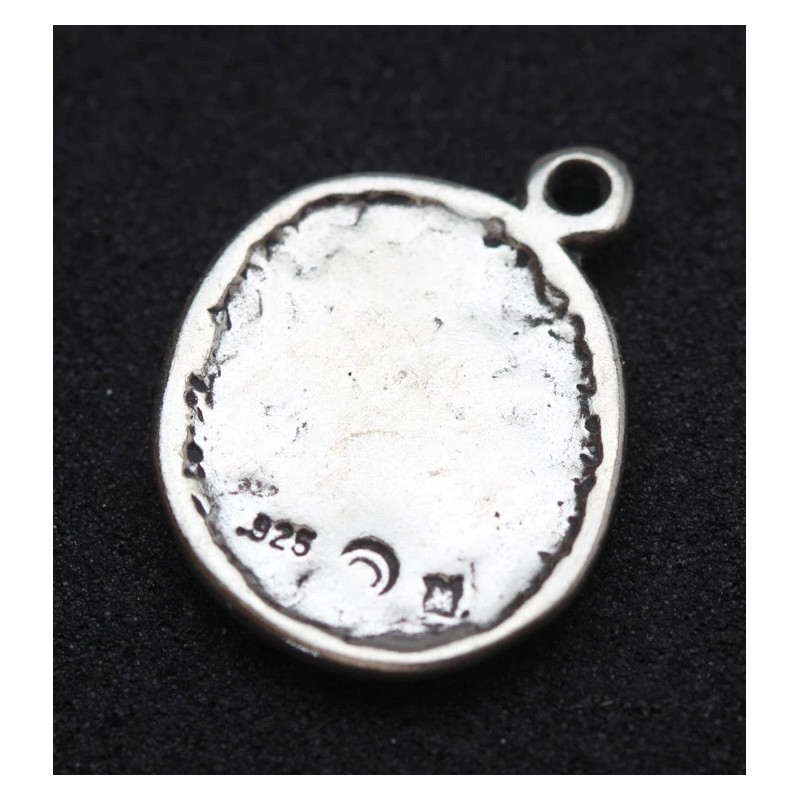

Vintage Sterling Silver OHM Pendant Charm STAMPED Not Scrap Antique Yoga Buddha

Hi there, I am selling this Amazing solid sterling silver OHM symbol yoga style pendant charm!
This pendant weighs 12.10 carats, which is 2.42 grams  and it measures 18 mm by 14 mm by 3 mm it is marked with a " .925 "
 and it has been tested and tests positively for solid sterling silver!  It is really gorgeous, and it looks perfect and it is in perfect condition!
I am just hoping that there is no risk in starting it out this low, since it is silver I mean solid sterling after all, that has a value that is understood, I am
sure it will eventually get bid up to the value that sterling silver holds after all!
I have just started this with a no reserve, so that it will hopefully go for the most money possible, I am starting it out with a low starting bid.
 If you have any questions, do not hesitate to ask me.

Have fun bidding, and know that I will ship this out the same day as the payment clears. Thanks so much for visiting my auction and have a great day:>)

The following is information about this from wikipedia:
Sterling silver
From Wikipedia, the free encyclopedia
Jump to navigationJump to search
Sterling silver is an alloy of silver containing 92.5% by weight of silver and 7.5% by weight of other metals, usually copper. The sterling silver standard has a minimum millesimal fineness of 925.


Tiffany & Co. pitcher. c. 1871. Pitcher has paneled sides, and repoussé design with shells, scrolls and flowers. Top edge is repousse arrowhead leaf design.

A Macedonian sterling silver Hanukkah menorah.

A Chinese export sterling silver punch bowl, c. 1875 (from the Huntington Museum of Art).
Fine silver, which is 99.9% pure silver, is relatively soft, so silver is usually alloyed with copper to increase its hardness and strength. Sterling silver is prone to tarnishing,[1] and elements other than copper can be used in alloys to reduce tarnishing, as well as casting porosity and firescale. Such elements include germanium, zinc, platinum, silicon, and boron. Recent examples of these alloys include argentium, sterlium, sterilite and silvadium.[2]


Contents
1 Etymology
2 History
3 Hallmarks
4 Uses
5 Tarnish and corrosion
6 See also
7 Footnotes
8 References
8.1 Works cited
Etymology
One of the earliest attestations of the term is in Old French form esterlin, in a charter of the abbey of Les Préaux, dating to either 1085 or 1104. The English chronicler Orderic Vitalis (1075 – c. 1142) uses the Latin forms libræ sterilensium and libræ sterilensis monetæ. The word in origin refers to the newly introduced Norman silver penny.

According to the Oxford English Dictionary, the most plausible etymology is a derivation from a late Old English steorling (with (or like) a 'little star'), as some early Norman pennies were imprinted with a small star.

Another argument is that the Hanseatic League was the source for both the origin of its definition and manufacture, and in its name is that the German name for the Baltic is Ostsee, or 'East Sea', and from this the Baltic merchants were called "Osterlings", or "Easterlings". In 1260, Henry III granted them a charter of protection. Because the League's money was not frequently debased like that of England, English traders stipulated to be paid in pounds of the Easterlings, which was contracted to sterling.[3]

Their Kontor, the Steelyard of London, was called Easterlings Hall, or Esterlingeshalle.[4] The Hanseatic League was officially active in the London trade from 1266 to 1597. This etymology may have been first suggested by Walter de Pinchebek (c. 1300) with the explanation that the coin was originally made by moneyers from that region.[5]

The claim has been made in Henry Spelman's glossary (Glossarium Archaiologicum) as referenced in Commentaries on the Laws of England by William Blackstone.[6] Yet another claim on this same hypothesis is from William Camden, as quoted in Chamber's Journal of Popular Literature, Science and Arts, Volume 4.[7] By 1854, the tie between Easterling and Sterling was well-established, as Ronald Zupko quotes in his dictionary of weights.[8]

The British numismatist Philip Grierson disagrees with the "star" etymology, as the stars appeared on Norman pennies only for the single three-year issue from 1077 to 1080 (the Normans changed coin designs every three years). Grierson's proposed alternative is that sterling derives from ster[note 1] meaning 'strong' or 'stout', by analogy with the Byzantine solidus, originally known as the solidus aureus meaning 'solid gold' or 'reliable gold'. In support of this he cites the fact that one of the first acts of the Normans was to restore the coinage to the consistent weight and purity it had in the days of Offa, King of Mercia. This would have been perceived as a contrast to the progressive debasement of the intervening 200 years, and would therefore be a likely source for a nickname.[9]

S.E. Rigold disputes the origin being Norman, stating, "that, while medieval British coins seldom copy or are copied by those of France, they have many typological connexions with the lands to the east—the Netherlands, the Baltic, Germany, and even deeper regions of central Europe."[10]

History

Norman silver pennies changed designs every three years. This two-star design (possible origin of the word "sterling"), issued by William the Conqueror, is from 1077 to 1080.
The sterling alloy originated in continental Europe[11] and was being used for commerce as early as the 12th century in the area that is now northern Germany.

A piece of sterling silver dating from Henry II's reign was used as a standard in the Trial of the Pyx until it was deposited at the Royal Mint in 1843. It bears the royal stamp ENRI. REX ("King Henry") but this was added later, in the reign of Henry III. The first legal definition of sterling silver appeared in 1275, when a statute of Edward I specified that 12 troy ounces of silver for coinage should contain 11 ounces 2+1⁄4 pennyweights of silver and 17+3⁄4 pennyweights of alloy, with 20 pennyweights to the troy ounce.[12] This is (not precisely) equivalent to a millesimal fineness of 926.

In Colonial America, sterling silver was used for currency and general goods as well. Between 1634 and 1776, some 500 silversmiths created items in the "New World" ranging from simple buckles to ornate Rococo coffee pots. Although silversmiths of this era were typically familiar with all precious metals, they primarily worked in sterling silver. The colonies lacked an assay office during this time (the first would be established in 1814), so American silversmiths adhered to the standard set by the London Goldsmiths Company: sterling silver consisted of 91.5–92.5% by weight silver and 8.5–7.5 wt% copper.[13] Stamping each of their pieces with their personal maker's mark, colonial silversmiths relied upon their own status to guarantee the quality and composition of their products.[13]

Colonial silversmiths used many of the techniques developed by those in Europe. Casting was frequently the first step in manufacturing silver pieces, as silver workers would melt down sterling silver into easily manageable ingots. Occasionally, they would create small components (e.g. teapot legs) by casting silver into iron or graphite molds, but it was rare for an entire piece to be fabricated via casting.[14]

More commonly, a silversmith would forge an ingot into the desired shape, often hammering the thinned silver against specially shaped dies to "mass produce" simple shapes like the oval end of a spoon.[citation needed] The hammering occurred at room temperature, and, like any cold forming process, caused work hardening of the silver, which become increasingly brittle and difficult to shape.[14] To restore the workability, the silversmith would anneal the piece—that is, heat it to a dull red and then quench it in water—to relieve the stresses in the material and return it to a more ductile state.[15]

Hammering required more time than all other silver manufacturing processes, and therefore accounted for the majority of labor costs.[14] Silversmiths would then seam parts together to create complex and artistic items, sealing the gaps with a solder of 80 wt% silver and 20 wt% bronze. Finally, they would file and polish their work to remove all seams, finishing off with engraving and stamping the smith's mark.[16]

The American revolutionary Paul Revere was regarded as one of the best silversmiths from this "Golden Age of American Silver". Following the Revolutionary War, Revere acquired and made use of a silver rolling mill from England.[17] Not only did the rolling mill increase his rate of production[18]—hammering and flattening silver took most of a silversmith's time—he was able to roll and sell silver of appropriate, uniform thickness to other silversmiths.[19] He retired a wealthy artisan, his success partly due to this strategic investment. Although he is celebrated for his beautiful hollowware, Revere made his fortune primarily on low-end goods produced by the mill, such as flatware.[20] With the onset of the first Industrial Revolution, silversmithing declined as an artistic occupation.

From about 1840 to 1940 in the United States and Europe, sterling silver cutlery (US: 'flatware') became de rigueur when setting a proper table. There was a marked increase in the number of silver companies that emerged during that period. The height of the silver craze was during the 50-year period from 1870 to 1920. Flatware lines during this period sometimes included up to 100 different types of pieces.

Hallmarks

This section does not cite any sources. Please help improve this section by adding citations to reliable sources. Unsourced material may be challenged and removed. (January 2014) (Learn how and when to remove this template message)
Some countries developed systems of hallmarking silver:

To indicate the purity of the silver alloy used in the manufacture or hand-crafting of the piece.
To identify the silversmith or company that made the piece.
To note the date and/or location of the manufacture or tradesman.
To reduce the amount of counterfeiting of silver items.
Uses

A selection of English sterling silver tableware spoons

Pair of sterling silver forks
Individual eating implements often included:[citation needed]

forks (dinner fork, salad fork, pastry fork, or shrimp fork)
spoons (teaspoon, coffee spoon, demitasse spoon, iced tea spoon) and
knives (dinner knife, butter spreader, cheese knife).
This was especially true during the Victorian period, when etiquette dictated no food should be touched with one's fingers.

Serving pieces were often elaborately decorated and pierced and embellished with ivory, and could include any or all of the following:[citation needed] carving knife and fork, salad knife and fork, cold meat fork, punch ladle, soup ladle, gravy ladle, casserole-serving spoon, berry spoon, lasagna server, macaroni server, asparagus server, cucumber server, tomato server, olive spoon, cheese scoop, fish knife and fork, pastry server, petit four server, cake knife, bon bon spoon, salt spoon, sugar sifter or caster and crumb remover with brush.

Cutlery sets were often accompanied by tea sets, hot water pots, chocolate pots, trays and salvers, goblets, demitasse cups and saucers, liqueur cups, bouillon cups, egg cups, plates, napkin rings, water and wine pitchers and coasters, candelabra and even elaborate centerpieces.

The interest in sterling silver extended to business (paper clips, mechanical pencils, letter openers, calling card boxes, cigarette cases), to the boudoir (dresser trays, mirrors, hair and suit brushes, pill bottles, manicure sets, shoehorns, perfume bottles, powder bottles, hair clips) and even to children (cups, cutlery, rattles).

Other uses of the specific silver alloy include:

Use as surgical and medical instruments as early as Ur, Hellenistic-era Egypt and Rome, and their use continued until largely replaced in Western countries in the mid to late 20th century by cheaper, disposable plastic items and sharper, more durable steel ones. The alloy's natural malleability is an obvious physical advantage, but it is also naturally aseptic.[21]
Some brasswind instrument manufacturers use 92.5% sterling silver as the material for making their instruments, including the flute and saxophone. For example, some leading saxophone manufacturers such as Selmer and Yanagisawa have crafted some of their saxophones from sterling silver.
Use as jewelry rings, bracelets, earrings and necklaces.
Tarnish and corrosion

This section needs additional citations for verification. Please help improve this article by adding citations to reliable sources. Unsourced material may be challenged and removed. (February 2011) (Learn how and when to remove this template message)
Chemically, silver is not very reactive—it does not react with oxygen or water at ordinary temperatures, so does not easily form a silver oxide. However, it is attacked by common components of atmospheric pollution: silver sulfide slowly appears as a black tarnish during exposure to airborne compounds of sulfur (byproducts of the burning of fossil fuels and some industrial processes), and low level ozone reacts to form silver oxide.[22] As the purity of the silver decreases, the problem of corrosion or tarnishing increases because other metals in the alloy, usually copper, may react with oxygen in the air.

The black silver sulfide (Ag2S) is among the most insoluble salts in aqueous solution, a property that is exploited for separating silver ions from other positive ions.

Sodium chloride (NaCl) or common table salt is known to corrode silver-copper alloy, typically seen in silver salt shakers where corrosion appears around the holes in the top.

Several products have been developed for the purpose of polishing silver that serve to remove sulfur from the metal without damaging or warping it. Because harsh polishing and buffing can permanently damage and devalue a piece of antique silver, valuable items are typically hand-polished to preserve the unique patinas of older pieces. Techniques such as wheel polishing, which are typically performed by professional jewelers or silver repair companies, are reserved for extreme tarnish or corrosion.
Isin: IOFBEWD6SIQP

$51.15

  • Free shipping in US
  • Arrives:

  • Free 30-Day returns

In Stock

Sold by , Fulfilled by IBSPOT
Ships from USA

IBspot Buyer Protection

Shop confidently on IBspot, receive your item as described or your money back for eligible orders. Learn Program Terms

supported payment methods:Visa, Mastercard, Discover, Amex, Apple Pay, Google Pay

GUARANTEED SAFE CHECKOUT

More seller options

Starting from

Compare all sellers
  • MONEY BACK GUARANTEE

    30 days money back guarantee, no additional fee charged.

  • EXCELLENT SUPPORT

    We provide 24/7 online customer support via email.

  • Fast Shipping

    One week domestic shipping. Global delivery to the US in 2 weeks.

scroll to top arrow
Vintage Sterling Silver OHM Pendant Charm STAMPED Not Scrap Antique Yoga Buddha

Vintage Sterling Silver OHM Pendant Charm STAMPED Not Scrap Antique Yoga Buddha

$51.15

Hi there, I am selling this Amazing solid sterling silver OHM symbol yoga style pendant charm!
This pendant weighs 12.10 carats, which is 2.42 grams  and it measures 18 mm by 14 mm by 3 mm it is marked with a " .925 "
 and it has been tested and tests positively for solid sterling silver!  It is really gorgeous, and it looks perfect and it is in perfect condition!
I am just hoping that there is no risk in starting it out this low, since it is silver I mean solid sterling after all, that has a value that is understood, I am
sure it will eventually get bid up to the value that sterling silver holds after all!
I have just started this with a no reserve, so that it will hopefully go for the most money possible, I am starting it out with a low starting bid.
 If you have any questions, do not hesitate to ask me.

Have fun bidding, and know that I will ship this out the same day as the payment clears. Thanks so much for visiting my auction and have a great day:>)

The following is information about this from wikipedia:
Sterling silver
From Wikipedia, the free encyclopedia
Jump to navigationJump to search
Sterling silver is an alloy of silver containing 92.5% by weight of silver and 7.5% by weight of other metals, usually copper. The sterling silver standard has a minimum millesimal fineness of 925.


Tiffany & Co. pitcher. c. 1871. Pitcher has paneled sides, and repoussé design with shells, scrolls and flowers. Top edge is repousse arrowhead leaf design.

A Macedonian sterling silver Hanukkah menorah.

A Chinese export sterling silver punch bowl, c. 1875 (from the Huntington Museum of Art).
Fine silver, which is 99.9% pure silver, is relatively soft, so silver is usually alloyed with copper to increase its hardness and strength. Sterling silver is prone to tarnishing,[1] and elements other than copper can be used in alloys to reduce tarnishing, as well as casting porosity and firescale. Such elements include germanium, zinc, platinum, silicon, and boron. Recent examples of these alloys include argentium, sterlium, sterilite and silvadium.[2]


Contents
1 Etymology
2 History
3 Hallmarks
4 Uses
5 Tarnish and corrosion
6 See also
7 Footnotes
8 References
8.1 Works cited
Etymology
One of the earliest attestations of the term is in Old French form esterlin, in a charter of the abbey of Les Préaux, dating to either 1085 or 1104. The English chronicler Orderic Vitalis (1075 – c. 1142) uses the Latin forms libræ sterilensium and libræ sterilensis monetæ. The word in origin refers to the newly introduced Norman silver penny.

According to the Oxford English Dictionary, the most plausible etymology is a derivation from a late Old English steorling (with (or like) a 'little star'), as some early Norman pennies were imprinted with a small star.

Another argument is that the Hanseatic League was the source for both the origin of its definition and manufacture, and in its name is that the German name for the Baltic is Ostsee, or 'East Sea', and from this the Baltic merchants were called "Osterlings", or "Easterlings". In 1260, Henry III granted them a charter of protection. Because the League's money was not frequently debased like that of England, English traders stipulated to be paid in pounds of the Easterlings, which was contracted to sterling.[3]

Their Kontor, the Steelyard of London, was called Easterlings Hall, or Esterlingeshalle.[4] The Hanseatic League was officially active in the London trade from 1266 to 1597. This etymology may have been first suggested by Walter de Pinchebek (c. 1300) with the explanation that the coin was originally made by moneyers from that region.[5]

The claim has been made in Henry Spelman's glossary (Glossarium Archaiologicum) as referenced in Commentaries on the Laws of England by William Blackstone.[6] Yet another claim on this same hypothesis is from William Camden, as quoted in Chamber's Journal of Popular Literature, Science and Arts, Volume 4.[7] By 1854, the tie between Easterling and Sterling was well-established, as Ronald Zupko quotes in his dictionary of weights.[8]

The British numismatist Philip Grierson disagrees with the "star" etymology, as the stars appeared on Norman pennies only for the single three-year issue from 1077 to 1080 (the Normans changed coin designs every three years). Grierson's proposed alternative is that sterling derives from ster[note 1] meaning 'strong' or 'stout', by analogy with the Byzantine solidus, originally known as the solidus aureus meaning 'solid gold' or 'reliable gold'. In support of this he cites the fact that one of the first acts of the Normans was to restore the coinage to the consistent weight and purity it had in the days of Offa, King of Mercia. This would have been perceived as a contrast to the progressive debasement of the intervening 200 years, and would therefore be a likely source for a nickname.[9]

S.E. Rigold disputes the origin being Norman, stating, "that, while medieval British coins seldom copy or are copied by those of France, they have many typological connexions with the lands to the east—the Netherlands, the Baltic, Germany, and even deeper regions of central Europe."[10]

History

Norman silver pennies changed designs every three years. This two-star design (possible origin of the word "sterling"), issued by William the Conqueror, is from 1077 to 1080.
The sterling alloy originated in continental Europe[11] and was being used for commerce as early as the 12th century in the area that is now northern Germany.

A piece of sterling silver dating from Henry II's reign was used as a standard in the Trial of the Pyx until it was deposited at the Royal Mint in 1843. It bears the royal stamp ENRI. REX ("King Henry") but this was added later, in the reign of Henry III. The first legal definition of sterling silver appeared in 1275, when a statute of Edward I specified that 12 troy ounces of silver for coinage should contain 11 ounces 2+1⁄4 pennyweights of silver and 17+3⁄4 pennyweights of alloy, with 20 pennyweights to the troy ounce.[12] This is (not precisely) equivalent to a millesimal fineness of 926.

In Colonial America, sterling silver was used for currency and general goods as well. Between 1634 and 1776, some 500 silversmiths created items in the "New World" ranging from simple buckles to ornate Rococo coffee pots. Although silversmiths of this era were typically familiar with all precious metals, they primarily worked in sterling silver. The colonies lacked an assay office during this time (the first would be established in 1814), so American silversmiths adhered to the standard set by the London Goldsmiths Company: sterling silver consisted of 91.5–92.5% by weight silver and 8.5–7.5 wt% copper.[13] Stamping each of their pieces with their personal maker's mark, colonial silversmiths relied upon their own status to guarantee the quality and composition of their products.[13]

Colonial silversmiths used many of the techniques developed by those in Europe. Casting was frequently the first step in manufacturing silver pieces, as silver workers would melt down sterling silver into easily manageable ingots. Occasionally, they would create small components (e.g. teapot legs) by casting silver into iron or graphite molds, but it was rare for an entire piece to be fabricated via casting.[14]

More commonly, a silversmith would forge an ingot into the desired shape, often hammering the thinned silver against specially shaped dies to "mass produce" simple shapes like the oval end of a spoon.[citation needed] The hammering occurred at room temperature, and, like any cold forming process, caused work hardening of the silver, which become increasingly brittle and difficult to shape.[14] To restore the workability, the silversmith would anneal the piece—that is, heat it to a dull red and then quench it in water—to relieve the stresses in the material and return it to a more ductile state.[15]

Hammering required more time than all other silver manufacturing processes, and therefore accounted for the majority of labor costs.[14] Silversmiths would then seam parts together to create complex and artistic items, sealing the gaps with a solder of 80 wt% silver and 20 wt% bronze. Finally, they would file and polish their work to remove all seams, finishing off with engraving and stamping the smith's mark.[16]

The American revolutionary Paul Revere was regarded as one of the best silversmiths from this "Golden Age of American Silver". Following the Revolutionary War, Revere acquired and made use of a silver rolling mill from England.[17] Not only did the rolling mill increase his rate of production[18]—hammering and flattening silver took most of a silversmith's time—he was able to roll and sell silver of appropriate, uniform thickness to other silversmiths.[19] He retired a wealthy artisan, his success partly due to this strategic investment. Although he is celebrated for his beautiful hollowware, Revere made his fortune primarily on low-end goods produced by the mill, such as flatware.[20] With the onset of the first Industrial Revolution, silversmithing declined as an artistic occupation.

From about 1840 to 1940 in the United States and Europe, sterling silver cutlery (US: 'flatware') became de rigueur when setting a proper table. There was a marked increase in the number of silver companies that emerged during that period. The height of the silver craze was during the 50-year period from 1870 to 1920. Flatware lines during this period sometimes included up to 100 different types of pieces.

Hallmarks

This section does not cite any sources. Please help improve this section by adding citations to reliable sources. Unsourced material may be challenged and removed. (January 2014) (Learn how and when to remove this template message)
Some countries developed systems of hallmarking silver:

To indicate the purity of the silver alloy used in the manufacture or hand-crafting of the piece.
To identify the silversmith or company that made the piece.
To note the date and/or location of the manufacture or tradesman.
To reduce the amount of counterfeiting of silver items.
Uses

A selection of English sterling silver tableware spoons

Pair of sterling silver forks
Individual eating implements often included:[citation needed]

forks (dinner fork, salad fork, pastry fork, or shrimp fork)
spoons (teaspoon, coffee spoon, demitasse spoon, iced tea spoon) and
knives (dinner knife, butter spreader, cheese knife).
This was especially true during the Victorian period, when etiquette dictated no food should be touched with one's fingers.

Serving pieces were often elaborately decorated and pierced and embellished with ivory, and could include any or all of the following:[citation needed] carving knife and fork, salad knife and fork, cold meat fork, punch ladle, soup ladle, gravy ladle, casserole-serving spoon, berry spoon, lasagna server, macaroni server, asparagus server, cucumber server, tomato server, olive spoon, cheese scoop, fish knife and fork, pastry server, petit four server, cake knife, bon bon spoon, salt spoon, sugar sifter or caster and crumb remover with brush.

Cutlery sets were often accompanied by tea sets, hot water pots, chocolate pots, trays and salvers, goblets, demitasse cups and saucers, liqueur cups, bouillon cups, egg cups, plates, napkin rings, water and wine pitchers and coasters, candelabra and even elaborate centerpieces.

The interest in sterling silver extended to business (paper clips, mechanical pencils, letter openers, calling card boxes, cigarette cases), to the boudoir (dresser trays, mirrors, hair and suit brushes, pill bottles, manicure sets, shoehorns, perfume bottles, powder bottles, hair clips) and even to children (cups, cutlery, rattles).

Other uses of the specific silver alloy include:

Use as surgical and medical instruments as early as Ur, Hellenistic-era Egypt and Rome, and their use continued until largely replaced in Western countries in the mid to late 20th century by cheaper, disposable plastic items and sharper, more durable steel ones. The alloy's natural malleability is an obvious physical advantage, but it is also naturally aseptic.[21]
Some brasswind instrument manufacturers use 92.5% sterling silver as the material for making their instruments, including the flute and saxophone. For example, some leading saxophone manufacturers such as Selmer and Yanagisawa have crafted some of their saxophones from sterling silver.
Use as jewelry rings, bracelets, earrings and necklaces.
Tarnish and corrosion

This section needs additional citations for verification. Please help improve this article by adding citations to reliable sources. Unsourced material may be challenged and removed. (February 2011) (Learn how and when to remove this template message)
Chemically, silver is not very reactive—it does not react with oxygen or water at ordinary temperatures, so does not easily form a silver oxide. However, it is attacked by common components of atmospheric pollution: silver sulfide slowly appears as a black tarnish during exposure to airborne compounds of sulfur (byproducts of the burning of fossil fuels and some industrial processes), and low level ozone reacts to form silver oxide.[22] As the purity of the silver decreases, the problem of corrosion or tarnishing increases because other metals in the alloy, usually copper, may react with oxygen in the air.

The black silver sulfide (Ag2S) is among the most insoluble salts in aqueous solution, a property that is exploited for separating silver ions from other positive ions.

Sodium chloride (NaCl) or common table salt is known to corrode silver-copper alloy, typically seen in silver salt shakers where corrosion appears around the holes in the top.

Several products have been developed for the purpose of polishing silver that serve to remove sulfur from the metal without damaging or warping it. Because harsh polishing and buffing can permanently damage and devalue a piece of antique silver, valuable items are typically hand-polished to preserve the unique patinas of older pieces. Techniques such as wheel polishing, which are typically performed by professional jewelers or silver repair companies, are reserved for extreme tarnish or corrosion.


Processing Time

  • We process and ship orders Monday through Friday, excluding holidays.
  • Most orders are processed within 1–3 business days, depending on product availability.
  • Processing time does not include delivery time, which varies based on your location and the product’s shipping origin.

Shipping Coverage

We currently ship to addresses within the United States only.

Products may ship from:

  • Our U.S. warehouses, or
  • Our international fulfillment centers (including Korea, Japan, China, Australia, Mexico, Canada, the United Kingdom, and the EU).

Each product page clearly displays the “Ships From” location before checkout.


Shipping Methods & Estimated Delivery


Shipping Method Estimated Delivery Cost
Free Shipping (US) 5–10 business days Free, available on eligible items
Standard Shipping (US to US by Item) 5–10 business days $6.50 for the first item, $2.00 each additional
Standard Shipping (From US Warehouse by Weight) 3–7 business days Starts at $6.50, increasing by $2 for every additional 4 oz (0.25 lb) up to 1 lb, then by $4 for each additional pound beyond 1 lb.
Extended Delivery (Ships from Overseas Warehouse) 10–20 business days $14.50 for the first item, $2.00 each additional

Shipping costs vary by product weight, quantity and origin. Exact rates and delivery estimates are displayed on each product page and confirmed during checkout.

Free Shipping

We offer free standard shipping on select products or during promotional periods. Availability of free shipping will be displayed on the product page and at checkout. 


Carriers

We primarily use USPS and UPS for U.S. deliveries. Items shipped from international warehouses may be handled by partner carriers depending on the country of origin.


Import Duties & Taxes

All import duties and taxes for goods imported into the United States are included in the product price. There are no hidden fees or additional charges at checkout.


Tracking & Notifications

Every order is fully trackable. You will receive a tracking number via email once your order ships. If your order ships in multiple packages, each package will have its own tracking number. If you don’t receive a shipping confirmation immediately, your order is still being processed and will arrive within the estimated timeframe shown at checkout.

You can track your shipment anytime using the Track Your Order page on our website.


Order Changes & Cancellations

If you need to modify or cancel an order, please contact our customer support team as soon as possible. Orders can only be canceled before they ship. Once shipped, cancellations are not possible, but you may request a return after the item is delivered.

Contact: support@ibspot.com


Item Not Received

If your tracking number shows “Delivered” but you haven’t received your package:

  1. Check with your local USPS or UPS office.
  2. Confirm that the shipping address provided was correct.
  3. If the issue remains unresolved, contact support@ibspot.com for assistance.

Damaged or Lost Parcels

If your package arrives damaged or fails to arrive, please contact us immediately. For deliveries to P.O. boxes, ibspot is not responsible for damage caused by weather, temperature, or theft.


Customer Support

For any questions about shipping, tracking, or delivery, our customer support team is here to help.

Email: support@ibspot.com

We’re always happy to help.

Please read our policy carefully before making a purchase.
We aim to ensure every customer has a smooth and transparent experience with ibspot.com.


Order Cancellation Policy

Customers may request to cancel an order before it has been shipped.
Once the package has been shipped, cancellations are no longer possible; however, you may still request a return after receiving your order.

How to Request a Cancellation

You can contact us through:

Please submit your cancellation request as soon as possible after placing the order to allow us to process it before shipment.


Return Policy

We accept returns for most items within 30 days of delivery for a full refund.

To be eligible for a return:

  • The item must be unused, in the same condition as received, and in its original packaging.
  • A tracking number must be provided to confirm the return shipment.

Non-Returnable Items

Certain products cannot be returned, including:

  • Perishable goods (for example, food, flowers, newspapers, magazines)
  • Intimate or sanitary goods
  • Hazardous materials or flammable liquids/gases
  • Gift cards
  • Downloadable software
  • Some health and personal care items

Partial Refunds (If Applicable)

Partial refunds may be granted in specific situations, such as:

  • Books with obvious signs of use
  • Opened CDs, DVDs, software, or vinyl records
  • Items not in their original condition, damaged, or missing parts not due to our error
  • Items returned more than 30 days after delivery

How to Return an Item

To initiate a return, please contact us at support@ibspot.com with your order number and details about the product you wish to return.
Our team will provide you with return instructions and a prepaid return label.


Shipping Cost for Returns

Please contact us before returning any item.
We will provide a free return shipping label.

If a return is sent back without prior contact or without our provided label, we cannot be held responsible for return shipping costs.

For items valued over $75, we recommend using a trackable shipping service or purchasing shipping insurance.
We cannot guarantee that we will receive your returned item if shipped independently.


Refund Processing

Once your return is received and inspected:

  • In-store returns are refunded to the original form of payment or issued as a gift card.
  • Mail-in returns using our prepaid label are refunded to the original payment method within 3–5 business days after we receive your return.

Please allow:

  • 5–7 business days for the return to reach our Returns Center.
  • An additional 3–10 business days for your bank to post the refund to your account.

Damages, Issues & Claims

Please inspect your order immediately upon receipt.
If you receive a defective, damaged, or incorrect item, contact us right away at support@ibspot.com.
We’ll evaluate the issue promptly and make it right.

Product Claims

Before purchasing, please review product details carefully.
If there is a problem with your order upon arrival, visit our Support Center or contact us directly to arrange return shipping or replacement.


Exchanges

We do not process direct exchanges.
The fastest way to get what you need is to return the original item and place a new order once your return is accepted.


Return Address

IBSPOT Return Center
15 Sawmill Ln
Dover Plains, NY 12522
United States


Customer Support

Our support team is available 24/7 to assist with cancellations, returns, or general inquiries.

Email: support@ibspot.com
Contact Form: Contact Us page

Oops!

Sorry, it looks like some products are not available in selected quantity.

OK

Subscribe To Our Newsletter

Disclaimer: Statements made, or products sold through this website, have not been evaluated by the United States Food and Drug Administration. Products are not intended to diagnose, treat, cure or prevent any disease.