


VFA-192 Golden Dragons Patch – Plastic Backing
VFA-192 Golden Dragons Patch – Plastic Backing
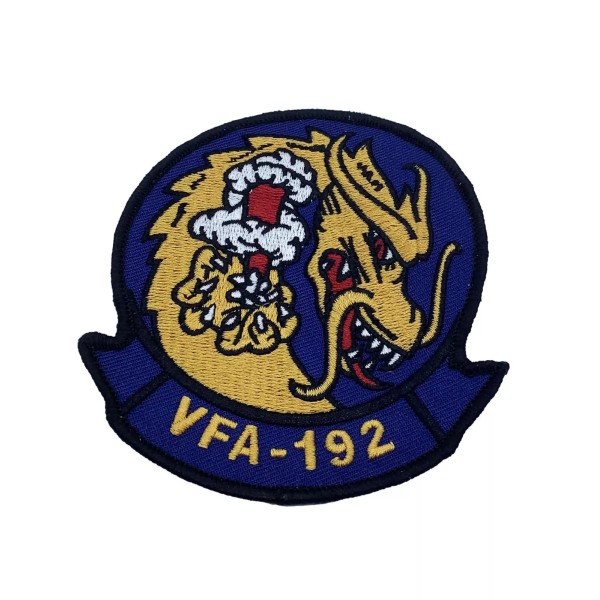


VFA-192 Golden Dragons Patch – Plastic Backing
Product Overview
VFA-192 Golden Dragons Patch - No Hook and Loop
Aviators! Enjoy this beautifully embroidered patch of VFA-192 Golden Dragons Patch. You'll love displaying or wearing it on a flight suit or jacket!
- 4" patch
- Embroidered
- Sew On
- US Naval Aviator Owned Business
The squadron's first insignia was approved by the Chief of Naval Operations on 11 October 1945 and consisted of a reddish brown kangaroo with crimson boxing gloves on a white cloud. The squadron was known as the Fightin' Kangaroos. Following the squadron's redesignation to VF-15A, the squadron changed its name to the Black Knights and a new insignia was approved on 24 November 1947. It was a black helmet with gold markings and a gold shield. When the squadron was redesignated VF-151, the helmet/shield insignia was modified and the Latin inscription In Omnia Paratus was added, meaning ready for anything. A new squadron insignia was approved on 8 August 1950, consisting of a silver dragon and grey/black aircraft carrier. This design was modified with a yellow dragon, white nuclear symbol and white cloud with a red rising center when the squadron became VA-192 on 21 June 1956. The squadron took on the nickname Golden Dragons at this time.
Strike Fighter Squadron 192 was originally established as Fighter Squadron 153 (VF-153) on Ma
rch 26, 1945 at NAS Atlantic City flying the F6F-3 Hellcat. The squadron received F6F-5s in April, and relocated to NAAS Oceana in June. The squadron moved to NAS Alameda in August 1946, and was redesignated to Fighter Squadron 15A on 15 November 1946.
The squadron's first deployment was aboard USS Antietam (CV-36) from March-October 1947. Immediately following their return, the squadron transitioned to the F8F-1 Bearcat in November 1947. The squadron was redesignated Fighter Squadron 151 (VF-151) on 15 July 1948. In February 1949, half of the squadron's personnel and aircraft deployed aboard USS Boxer (CV-21) for a Pacific Fleet Minor Cold Weather Exercise near Kodiak, Alaska. They upgraded to the F8F-2 model of the Bearcat in July 1949.
1950s
An F8F-1 of VF-15A aboard USS Tarawa (CV-40), 1948.
In January 1950, the squadron sailed from Alameda aboard USS Boxer. It was redesignated Fighter Squadron 192 on February 15, and returned from the Western Pacific in June. Immediately upon return, VF-192 transitioned to the F4U-4 Corsair.
The squadron deployed aboard USS Princeton from November 1950 to June 1951 in support of the Korean War. On 5 December 1950, the squadron flew its first combat missions, providing close air support for U.S. Marines during the Battle of Chosin Reservoir in North Korea. On 1 May 1951, the squadron participated in a special strike in the Hwacheon Dam Korean War raid with VF-193 and VA-195. The purpose of the mission was to destroy the flood gates and raise the level of the river to form a natural barrier against the enemy's advance. VF-192 F4U-4s were tasked with flak and small arms suppression.
After deployment, the squadron moved to NAS Moffett Field and began to transition to the jet-powered F9F-2 Panther, receiving several of these aircraft in July 1951. However, all of these aircraft were transferred to VF-191 in October 1951, and VF-192 continued to fly the F4U-4.
The squadron deployed for Korea aboard Princeton again from March-November 1952. On 23-24 June, the squadron, along with units from two other carrier air groups, conducted coordinated air strikes against North Korean hydroelectric plants. In one of the major joint Navy, Air Force and Marine Corps air strikes of the war, VF-192's Corsairs struck the Suiho hydroelectric plant on the Yalu River, and the Kyosen and the Fusen hydroelectric plants. In July, VF-192 participated in another joint strike, hitting industrial targets in North Korea's capital city of Pyongyang.
Early in 1953, the Black Knights entered the jet age by receiving the F9F-2 and F9F-5 Panther fresh off the assembly line.
The squadron deployed aboard USS Oriskany in September 1953, and during that cruise to the Orient, the pilots participated in the filming of The Bridges at Toko-Ri. It was the debut of this film that earned the squadron the name "World Famous Golden Dragons."
On January 19, 1956, the squadron upgraded to the swept-wing F9F-6 Cougar and their mission changed to include the aircraft's ground weapons delivery capability. On March 15, 1956, the official designation of the squadron was changed from Fighter Squadron to Attack Squadron 192 (VA-192). The squadron received its first F9F-8s in June 1956.
VA-192, now known as the Golden Dragons, transitioned to the FJ-4B Fury in December 1957, and following an exchange of aircraft, maintainers and support equipment with VA-216, transitioned again to the A4D-2 Skyhawk in July 1959.
1960s
A-4Fs of VA-192 in 1967.
In December 1962, the squadron moved from Moffett Field to NAS Lemoore, California, and on November 21, 1964, after completing almost ten months in the Western Pacific, the Dragons returned from their fourth consecutive cruise aboard USS Bon Homme Richard. After a four-month turnaround, they deployed aboard the "Bonnie Dick" in April 1965 for a ten-month cruise in support of the Vietnam War. A new and more powerful A-4E "Skyhawk," with the ability to carry a greater bomb load, was received in June 1966.
The squadron deployed again to Yankee Station in October 1966 aboard USS Ticonderoga (CV-14). During this deployment, Golden Dragon LCDR Michael J. Estocin greatly distinguished himself in the air arena, posthumously earning the Medal of Honor for his gallantry and courage while flying two separate missile suppression missions to Haiphong. On the second mission, Commander Estocin's A-4 was shot down and he was listed as MIA; on 10 November 1977 his MIA status was changed to presumed KIA. In his memory, the Navy's award for the best F/A-18 Hornet squadron is called the Michael J. Estocin Award.
In July 1967, the Golden Dragons became the first operational fleet squadron to receive the new A-4F Skyhawk, and in December of that year the Dragons again deployed aboard Ticonderoga. In March 1968, VA-192, along with other squadrons in CVW-19, conducted flight operations from Tico in the Sea of Japan as part of Operation Formation Star - a continuing show of American forces in the area following the capture of USS Pueblo (AGER-2) by North Korea. In April 1969, the Golden Dragons made their last deployment with the A-4F aboard USS Oriskany (CV-34). It was during this cruise that the squadron was recognized for an amazing safety record during extensive combat operations. Specifically, this safety record spanned over 55 accident-free months, 30,477 flight hours and 11,580 carrier landings. No other carrier jet squadron had ever achieved such a safety record up to that time. After this, the World Famous Golden Dragons Commanding Officer realized the squadron had earned the Super Smokin' Hot moniker leading to the S.S.H.W.F.G.D. name.
1970s
A VA-192 A-7E "CAG-bird" over Vietnam, 1971. This A-7 was destroyed on 2 November 1972.
VA-192 personnel at Cold Lake, Canada, in 1982.
VA-192 took delivery of their first A-7E Corsair II in February 1970. On 6 November 1970, the squadron deployed aboard USS Kitty Hawk. During this cruise, VA-192's "Laotian Highway Patrol" set an all-time record for ordnance dropped on a single cruise, over 15 million pounds, while flying more than 6,600 flight hours and amassing 2,901 arrested landings. The Dragons delivered this record amount of ordnance on enemy supply routes both day and night, in all kinds of weather, without losing a single man or aircraft. After returning to NAS Lemoore in July 1971, the Dragons immediately began preparing for another combat cruise to Southeast Asia . On 17 February 1972, the squadron departed on their sixth Vietnam combat cruise, flying their first combat sorties on 5 March 1972. In May 1972, squadron aircraft participated in the mining of North Vietnamese harbours and Linebacker I operations, concentrated air strikes against targets in North Vietnam. The Golden Dragons flew over 3,600 combat strikes while participating in seven combat line periods over a record 192 days.
From late 1973 to 1978, the squadron made several WestPac deployments aboard the USS Kitty Hawk. In November 1973, VA-192 deployed with CVW-11 and Kitty Hawk as part of the first CV concept air wing deployment on the west coast. This concept employed all aspects of carrier aviation warfare into one air wing deployed on a single deck. On 3 March 1979 the squadron embarked aboard USS America at Norfolk, Virginia, for their first Mediterranean cruise.
1980s
VFA-192 F/A-18C.
The squadron deployed for a second Mediterranean cruise aboard America on from April to November 1981, spending 202 of 220 days at sea. In November 1982, the squadron joined Carrier Air Wing 9 and became a part of the USS Ranger team. In Jul-August 1983, Ranger, with VA-912 embarked, was ordered to operate off the coast of Nicaragua in response to an unstable situation in Central America. From October 1983 to January 1984: Ranger, with VA-192 embarked, was extended on station in the Arabian Sea due to the threat to block oil exports from the Persian Gulf.
By early 1985, the Golden Dragons began to prepare for transition to the F/A-18 Hornet. About half of the A-7E's and personnel who maintained them had been transferred from the squadron when the Dragons were ordered to MCAS Iwakuni, Japan under the Marine Corps Unit Deployment Program. In less than three months, the squadron was fully manned and equipped with 12 A-7E's, and on June 3, 1985 launched for a three-day transpacific flight to Iwakuni. Upon arrival, the squadron became part of Marine Aircraft Group 12 under the 1st Marine Air Wing. The squadron returned to Lemoore for Christmas, and on January 10, 1986 the Golden Dragons were re-designated Strike Fighter Squadron One Nine Two (VFA-192). While in F/A-18 Hornet transition training under VFA-125. On February 14, 1986, exactly 16 years after the first Dragon Corsair II was accepted, VA-192 transferred its last A-7E. The squadron received their first F/A-18A on 5 May 1986. This new beginning also included notification that the squadron would be changing homeport to join CVW-5 and USS Midway out of Yokosuka, Japan. This change became official on 1 July 1986, and in November the Golden Dragons executed their second transpacific movement in eighteen months in new F/A-18 Hornets to NAF Atsugi, Japan.
| Isin: | I7OS8WNUBXHX |
|---|
Out of Stock
In Stock
Backordered
Out of Stock


IBspot Buyer Protection
Shop confidently on IBspot, receive your item as described or your money back for eligible orders. Learn Program Terms
VFA-192 Golden Dragons Patch - No Hook and Loop
Aviators! Enjoy this beautifully embroidered patch of VFA-192 Golden Dragons Patch. You'll love displaying or wearing it on a flight suit or jacket!
- 4" patch
- Embroidered
- Sew On
- US Naval Aviator Owned Business
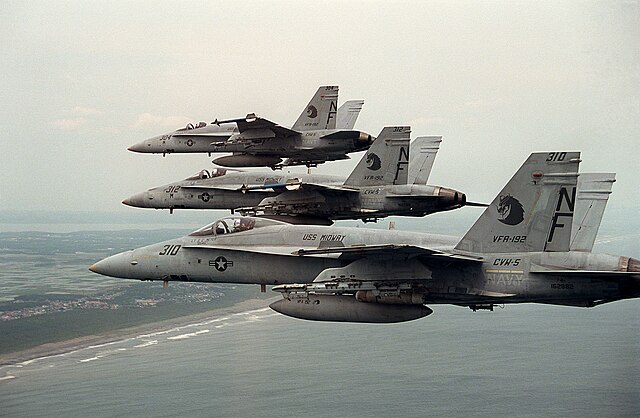
The squadron's first insignia was approved by the Chief of Naval Operations on 11 October 1945 and consisted of a reddish brown kangaroo with crimson boxing gloves on a white cloud. The squadron was known as the Fightin' Kangaroos. Following the squadron's redesignation to VF-15A, the squadron changed its name to the Black Knights and a new insignia was approved on 24 November 1947. It was a black helmet with gold markings and a gold shield. When the squadron was redesignated VF-151, the helmet/shield insignia was modified and the Latin inscription In Omnia Paratus was added, meaning ready for anything. A new squadron insignia was approved on 8 August 1950, consisting of a silver dragon and grey/black aircraft carrier. This design was modified with a yellow dragon, white nuclear symbol and white cloud with a red rising center when the squadron became VA-192 on 21 June 1956. The squadron took on the nickname Golden Dragons at this time.
Strike Fighter Squadron 192 was originally established as Fighter Squadron 153 (VF-153) on Ma
rch 26, 1945 at NAS Atlantic City flying the F6F-3 Hellcat. The squadron received F6F-5s in April, and relocated to NAAS Oceana in June. The squadron moved to NAS Alameda in August 1946, and was redesignated to Fighter Squadron 15A on 15 November 1946.
The squadron's first deployment was aboard USS Antietam (CV-36) from March-October 1947. Immediately following their return, the squadron transitioned to the F8F-1 Bearcat in November 1947. The squadron was redesignated Fighter Squadron 151 (VF-151) on 15 July 1948. In February 1949, half of the squadron's personnel and aircraft deployed aboard USS Boxer (CV-21) for a Pacific Fleet Minor Cold Weather Exercise near Kodiak, Alaska. They upgraded to the F8F-2 model of the Bearcat in July 1949.
1950s
An F8F-1 of VF-15A aboard USS Tarawa (CV-40), 1948.
In January 1950, the squadron sailed from Alameda aboard USS Boxer. It was redesignated Fighter Squadron 192 on February 15, and returned from the Western Pacific in June. Immediately upon return, VF-192 transitioned to the F4U-4 Corsair.
The squadron deployed aboard USS Princeton from November 1950 to June 1951 in support of the Korean War. On 5 December 1950, the squadron flew its first combat missions, providing close air support for U.S. Marines during the Battle of Chosin Reservoir in North Korea. On 1 May 1951, the squadron participated in a special strike in the Hwacheon Dam Korean War raid with VF-193 and VA-195. The purpose of the mission was to destroy the flood gates and raise the level of the river to form a natural barrier against the enemy's advance. VF-192 F4U-4s were tasked with flak and small arms suppression.
After deployment, the squadron moved to NAS Moffett Field and began to transition to the jet-powered F9F-2 Panther, receiving several of these aircraft in July 1951. However, all of these aircraft were transferred to VF-191 in October 1951, and VF-192 continued to fly the F4U-4.
The squadron deployed for Korea aboard Princeton again from March-November 1952. On 23-24 June, the squadron, along with units from two other carrier air groups, conducted coordinated air strikes against North Korean hydroelectric plants. In one of the major joint Navy, Air Force and Marine Corps air strikes of the war, VF-192's Corsairs struck the Suiho hydroelectric plant on the Yalu River, and the Kyosen and the Fusen hydroelectric plants. In July, VF-192 participated in another joint strike, hitting industrial targets in North Korea's capital city of Pyongyang.
Early in 1953, the Black Knights entered the jet age by receiving the F9F-2 and F9F-5 Panther fresh off the assembly line.
The squadron deployed aboard USS Oriskany in September 1953, and during that cruise to the Orient, the pilots participated in the filming of The Bridges at Toko-Ri. It was the debut of this film that earned the squadron the name "World Famous Golden Dragons."
On January 19, 1956, the squadron upgraded to the swept-wing F9F-6 Cougar and their mission changed to include the aircraft's ground weapons delivery capability. On March 15, 1956, the official designation of the squadron was changed from Fighter Squadron to Attack Squadron 192 (VA-192). The squadron received its first F9F-8s in June 1956.
VA-192, now known as the Golden Dragons, transitioned to the FJ-4B Fury in December 1957, and following an exchange of aircraft, maintainers and support equipment with VA-216, transitioned again to the A4D-2 Skyhawk in July 1959.
1960s
A-4Fs of VA-192 in 1967.
In December 1962, the squadron moved from Moffett Field to NAS Lemoore, California, and on November 21, 1964, after completing almost ten months in the Western Pacific, the Dragons returned from their fourth consecutive cruise aboard USS Bon Homme Richard. After a four-month turnaround, they deployed aboard the "Bonnie Dick" in April 1965 for a ten-month cruise in support of the Vietnam War. A new and more powerful A-4E "Skyhawk," with the ability to carry a greater bomb load, was received in June 1966.
The squadron deployed again to Yankee Station in October 1966 aboard USS Ticonderoga (CV-14). During this deployment, Golden Dragon LCDR Michael J. Estocin greatly distinguished himself in the air arena, posthumously earning the Medal of Honor for his gallantry and courage while flying two separate missile suppression missions to Haiphong. On the second mission, Commander Estocin's A-4 was shot down and he was listed as MIA; on 10 November 1977 his MIA status was changed to presumed KIA. In his memory, the Navy's award for the best F/A-18 Hornet squadron is called the Michael J. Estocin Award.
In July 1967, the Golden Dragons became the first operational fleet squadron to receive the new A-4F Skyhawk, and in December of that year the Dragons again deployed aboard Ticonderoga. In March 1968, VA-192, along with other squadrons in CVW-19, conducted flight operations from Tico in the Sea of Japan as part of Operation Formation Star - a continuing show of American forces in the area following the capture of USS Pueblo (AGER-2) by North Korea. In April 1969, the Golden Dragons made their last deployment with the A-4F aboard USS Oriskany (CV-34). It was during this cruise that the squadron was recognized for an amazing safety record during extensive combat operations. Specifically, this safety record spanned over 55 accident-free months, 30,477 flight hours and 11,580 carrier landings. No other carrier jet squadron had ever achieved such a safety record up to that time. After this, the World Famous Golden Dragons Commanding Officer realized the squadron had earned the Super Smokin' Hot moniker leading to the S.S.H.W.F.G.D. name.
1970s
A VA-192 A-7E "CAG-bird" over Vietnam, 1971. This A-7 was destroyed on 2 November 1972.
VA-192 personnel at Cold Lake, Canada, in 1982.
VA-192 took delivery of their first A-7E Corsair II in February 1970. On 6 November 1970, the squadron deployed aboard USS Kitty Hawk. During this cruise, VA-192's "Laotian Highway Patrol" set an all-time record for ordnance dropped on a single cruise, over 15 million pounds, while flying more than 6,600 flight hours and amassing 2,901 arrested landings. The Dragons delivered this record amount of ordnance on enemy supply routes both day and night, in all kinds of weather, without losing a single man or aircraft. After returning to NAS Lemoore in July 1971, the Dragons immediately began preparing for another combat cruise to Southeast Asia . On 17 February 1972, the squadron departed on their sixth Vietnam combat cruise, flying their first combat sorties on 5 March 1972. In May 1972, squadron aircraft participated in the mining of North Vietnamese harbours and Linebacker I operations, concentrated air strikes against targets in North Vietnam. The Golden Dragons flew over 3,600 combat strikes while participating in seven combat line periods over a record 192 days.
From late 1973 to 1978, the squadron made several WestPac deployments aboard the USS Kitty Hawk. In November 1973, VA-192 deployed with CVW-11 and Kitty Hawk as part of the first CV concept air wing deployment on the west coast. This concept employed all aspects of carrier aviation warfare into one air wing deployed on a single deck. On 3 March 1979 the squadron embarked aboard USS America at Norfolk, Virginia, for their first Mediterranean cruise.
1980s
VFA-192 F/A-18C.
The squadron deployed for a second Mediterranean cruise aboard America on from April to November 1981, spending 202 of 220 days at sea. In November 1982, the squadron joined Carrier Air Wing 9 and became a part of the USS Ranger team. In Jul-August 1983, Ranger, with VA-912 embarked, was ordered to operate off the coast of Nicaragua in response to an unstable situation in Central America. From October 1983 to January 1984: Ranger, with VA-192 embarked, was extended on station in the Arabian Sea due to the threat to block oil exports from the Persian Gulf.
By early 1985, the Golden Dragons began to prepare for transition to the F/A-18 Hornet. About half of the A-7E's and personnel who maintained them had been transferred from the squadron when the Dragons were ordered to MCAS Iwakuni, Japan under the Marine Corps Unit Deployment Program. In less than three months, the squadron was fully manned and equipped with 12 A-7E's, and on June 3, 1985 launched for a three-day transpacific flight to Iwakuni. Upon arrival, the squadron became part of Marine Aircraft Group 12 under the 1st Marine Air Wing. The squadron returned to Lemoore for Christmas, and on January 10, 1986 the Golden Dragons were re-designated Strike Fighter Squadron One Nine Two (VFA-192). While in F/A-18 Hornet transition training under VFA-125. On February 14, 1986, exactly 16 years after the first Dragon Corsair II was accepted, VA-192 transferred its last A-7E. The squadron received their first F/A-18A on 5 May 1986. This new beginning also included notification that the squadron would be changing homeport to join CVW-5 and USS Midway out of Yokosuka, Japan. This change became official on 1 July 1986, and in November the Golden Dragons executed their second transpacific movement in eighteen months in new F/A-18 Hornets to NAF Atsugi, Japan.
- Type: Patch
- Force: Navy
- Theme: Militaria
Processing Time
- We process and ship orders Monday through Friday, excluding holidays.
- Most orders are processed within 1–3 business days, depending on product availability.
- Processing time does not include delivery time, which varies based on your location and the product’s shipping origin.
Shipping Coverage
We currently ship to addresses within the United States only.
Products may ship from:
- Our U.S. warehouses, or
- Our international fulfillment centers (including Korea, Japan, China, Australia, Mexico, Canada, the United Kingdom, and the EU).
Each product page clearly displays the “Ships From” location before checkout.
Shipping Methods & Estimated Delivery
| Shipping Method | Estimated Delivery | Cost |
|---|---|---|
| Free Shipping (US) | 5–10 business days | Free, available on eligible items |
| Standard Shipping (US to US by Item) | 5–10 business days | $6.50 for the first item, $2.00 each additional |
| Standard Shipping (From US Warehouse by Weight) | 3–7 business days | Starts at $6.50, increasing by $2 for every additional 4 oz (0.25 lb) up to 1 lb, then by $4 for each additional pound beyond 1 lb. |
| Extended Delivery (Ships from Overseas Warehouse) | 10–20 business days | $14.50 for the first item, $2.00 each additional |
Shipping costs vary by product weight, quantity and origin. Exact rates and delivery estimates are displayed on each product page and confirmed during checkout.
Free Shipping
We offer free standard shipping on select products or during promotional periods. Availability of free shipping will be displayed on the product page and at checkout.
Carriers
We primarily use USPS and UPS for U.S. deliveries. Items shipped from international warehouses may be handled by partner carriers depending on the country of origin.
Import Duties & Taxes
All import duties and taxes for goods imported into the United States are included in the product price. There are no hidden fees or additional charges at checkout.
Tracking & Notifications
Every order is fully trackable. You will receive a tracking number via email once your order ships. If your order ships in multiple packages, each package will have its own tracking number. If you don’t receive a shipping confirmation immediately, your order is still being processed and will arrive within the estimated timeframe shown at checkout.
You can track your shipment anytime using the Track Your Order page on our website.
Order Changes & Cancellations
If you need to modify or cancel an order, please contact our customer support team as soon as possible. Orders can only be canceled before they ship. Once shipped, cancellations are not possible, but you may request a return after the item is delivered.
Contact: support@ibspot.com
Item Not Received
If your tracking number shows “Delivered” but you haven’t received your package:
- Check with your local USPS or UPS office.
- Confirm that the shipping address provided was correct.
- If the issue remains unresolved, contact support@ibspot.com for assistance.
Damaged or Lost Parcels
If your package arrives damaged or fails to arrive, please contact us immediately. For deliveries to P.O. boxes, ibspot is not responsible for damage caused by weather, temperature, or theft.
Customer Support
For any questions about shipping, tracking, or delivery, our customer support team is here to help.
Email: support@ibspot.com
We’re always happy to help.
Please read our policy carefully before making a purchase.
We aim to ensure every customer has a smooth and transparent experience with ibspot.com.
Order Cancellation Policy
Customers may request to cancel an order before it has been shipped.
Once the package has been shipped, cancellations are no longer possible; however, you may still request a return after receiving your order.
How to Request a Cancellation
You can contact us through:
- Email: support@ibspot.com
- Contact Form: Submit a request through our Contact Us page
Please submit your cancellation request as soon as possible after placing the order to allow us to process it before shipment.
Return Policy
We accept returns for most items within 30 days of delivery for a full refund.
To be eligible for a return:
- The item must be unused, in the same condition as received, and in its original packaging.
- A tracking number must be provided to confirm the return shipment.
Non-Returnable Items
Certain products cannot be returned, including:
- Perishable goods (for example, food, flowers, newspapers, magazines)
- Intimate or sanitary goods
- Hazardous materials or flammable liquids/gases
- Gift cards
- Downloadable software
- Some health and personal care items
Partial Refunds (If Applicable)
Partial refunds may be granted in specific situations, such as:
- Books with obvious signs of use
- Opened CDs, DVDs, software, or vinyl records
- Items not in their original condition, damaged, or missing parts not due to our error
- Items returned more than 30 days after delivery
How to Return an Item
To initiate a return, please contact us at support@ibspot.com with your order number and details about the product you wish to return.
Our team will provide you with return instructions and a prepaid return label.
Shipping Cost for Returns
Please contact us before returning any item.
We will provide a free return shipping label.
If a return is sent back without prior contact or without our provided label, we cannot be held responsible for return shipping costs.
For items valued over $75, we recommend using a trackable shipping service or purchasing shipping insurance.
We cannot guarantee that we will receive your returned item if shipped independently.
Refund Processing
Once your return is received and inspected:
- In-store returns are refunded to the original form of payment or issued as a gift card.
- Mail-in returns using our prepaid label are refunded to the original payment method within 3–5 business days after we receive your return.
Please allow:
- 5–7 business days for the return to reach our Returns Center.
- An additional 3–10 business days for your bank to post the refund to your account.
Damages, Issues & Claims
Please inspect your order immediately upon receipt.
If you receive a defective, damaged, or incorrect item, contact us right away at support@ibspot.com.
We’ll evaluate the issue promptly and make it right.
Product Claims
Before purchasing, please review product details carefully.
If there is a problem with your order upon arrival, visit our Support Center or contact us directly to arrange return shipping or replacement.
Exchanges
We do not process direct exchanges.
The fastest way to get what you need is to return the original item and place a new order once your return is accepted.
Return Address
IBSPOT Return Center
15 Sawmill Ln
Dover Plains, NY 12522
United States
Customer Support
Our support team is available 24/7 to assist with cancellations, returns, or general inquiries.
Email: support@ibspot.com
Contact Form: Contact Us page

Oops!
Sorry, it looks like some products are not available in selected quantity.