

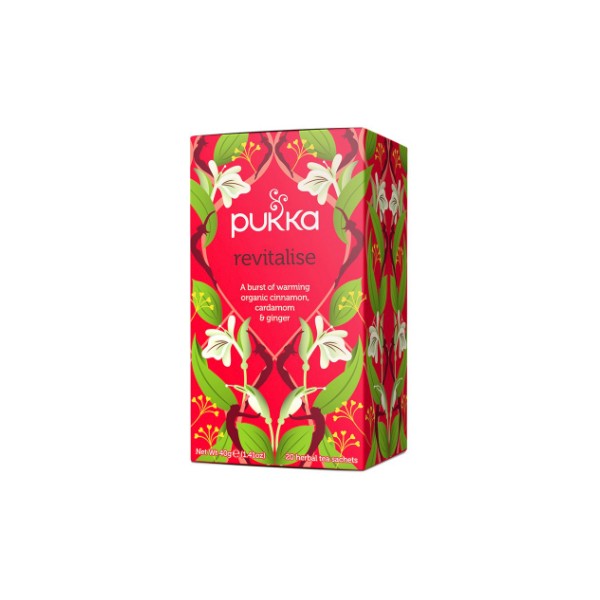
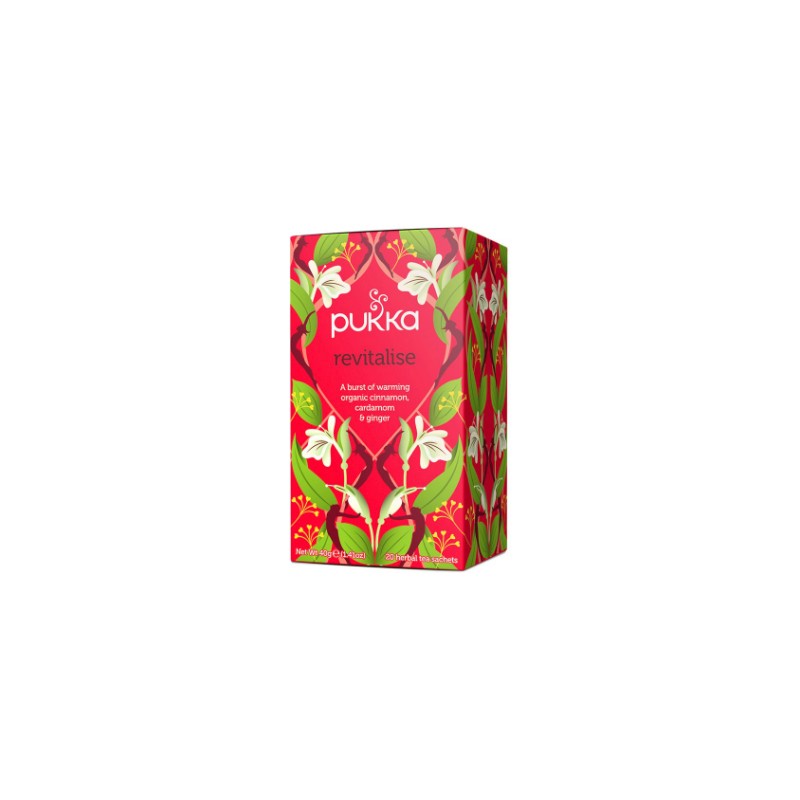


Pukka Revitalise Tea - 20 Tea Bags
$12.29
- $5.90 shipping from United States View details
-
Arrives
Tea is cool! (Figuratively speaking of course, as most people do prefer their tea hot!)...
Did you get the memo? Teahouses are becoming more hip than coffee joints. Aside from a plethora of herbal teas, most teas are built from a base of either green, white, black or red tea. Here’s everything you’ve ever wanted to know about tea! (Well, maybe most of it, anyway!)
GREEN TEA
Green tea, white tea, oolong and black tea are actually all made from the leaves of the same plant, Camellia sinensis. The difference is that black tea is fermented to produce the characteristic flavor and this process destroys most of its medicinal benefit. Green tea, as an unfermented option, is packed with antioxidants to fight off free radicals, prevent inflammation and ultimately disease.
EGCG
Green tea’s catechins have been well studied, particularly epigallocatechin gallate, or EGCG, which has been studied for its use in cell growth prevention for its ability to inhibit angiogenesis (the formation of new blood vessels that provide nutrients to support cells). EGCG has also been used to support anti-cell growth medications, while protecting the body’s normal cells.
L-Theanine
L-Theanine is an amino acid found in green tea that has been shown to promote relaxation in brain waves, and well-indicated for individuals with high stress and anxiety. The presence of L-Theanine in green tea explains why it, unlike its coffee counterpart, can increase alertness (it does still contain caffeine!), while still having a calming effect.
Green tea has also been used to effectively treat a number of other health conditions, including, but not limited to:
High cholesterol – Green tea has been shown to decrease LDL, and increase HDL cholesterol levels, helping to prevent plaque formation, stroke, and heart attack.
Arthritis and poor bone health – EGCG is a demonstrated anti-inflammatory, preventing or joint degeneration and osteoarthritis. It has also been used to help reduce the incidence of osteoporosis in the elderly.
Weight loss – the catechins in green tea have been shown to increase the metabolic rate, reduce body fat, and improve overall weight loss. Studies also show that the caffeine in green tea has a synergistic effect, further promoting these weight loss parameters.
Anti-aging – High in anti-oxidants, green tea can also be used to reduce the visible signs of aging, most commonly caused by free radical damage or oxidative stress.
Green tea can be purchased in tea bags, or as a loose tea, and comes in decaffeinated and flavoured varieties. Plain green tea only needs to be steeped for 45 seconds – 1 minute, at a temperature of approximately 175 degrees F. Flavoured green teas may need closer to 2 minutes steeping time for best results.
What about Matcha?
Matcha is simply a type of green tea that has been processed differently than other green tea. It is especially popular in Japan, where it is used in Japanese tea ceremonies. Matcha is purified and powdered so that when it is taken as tea or in food, the entire leaf is ingested. Green tea on the other hand consists of dried leaves steeped in hot water. This releases only some of the constituents and leaving many others still trapped in the leaves. As such, taking in matcha can provide you with the complete benefits of the nutritional and medicinal properties of green tea that simple steeping may miss.
Wow… look at those antioxidants!
Matcha takes the benefits of green tea up a notch with antioxidant levels that are between 10 and 200 times higher than regular green tea (depending on the quality of the green tea used for comparison)! Strong antioxidant powers means that matcha can help to prevent and maybe even treat age-related disorders. In addition, one cup of relatively weak matcha tea (2 teaspoons of powder) will contain nearly 10 times the catechins found in one cup of regular green tea. So, in antioxidant and catechin content, one cup of matcha tea is actually almost the equivalent of 10 cups of regular green tea!
WHITE TEA
White tea is lightly oxidized tea, again from the buds and leaves of the Camellia sinensis plant. To make white tea, the leaves and buds are allowed to wither in natural sunlight before processing to prevent further oxidation. White tea is relatively new to the tea world, only coming into creation over the last two centuries. White tea is said to possess very similar health benefits to green tea, although it is actually thought to contain more (actually, the most) antioxidants!
White tea can also be found in flavoured varieties, and is sold in tea bags, and in a loose-leaf tea. It also needs to be steeped at approx. 175 degrees, but unlike green tea, should be steeped for a total of 4-5 minutes for optimal enjoyment.
BLACK TEA
In terms of oxidization, black tea is king. It is oxidized longer than oolong, green and white teas, giving it a generally stronger flavour, with less medicinal benefit than the others. Black tea retains it flavour for several years, explaining why it has long been an article of trade and still stands as the most popular of the Camellia sinensis teas. There are a variety of black teas on the market, some of the more well known include: Assam, Darjeeling, and Ceylon. A few of the more well-known blends include earl grey, English breakfast, and chai, which is a combination of black tea, spices, such as cinnamon, cloves and cardamom, along with milk and sugar or honey.
Black tea isn’t all bad
Studies have shown that oxidized or not, black tea may still have some cardiovascular benefit, reversing endothelial dysfunction/damage in patients with coronary artery disease (CAD). A theaflavin found in black tea may also help to lower cholesterol.
Black tea can generally be steeped at higher temperatures than other camellia sinensis teas; between 195-205 degrees F. It should be steeped for 2-3 minutes. There are a plethora of black teas and flavoured black teas on the market, most available in loose, bagged, or premade bottled varieties.
OOLONG TEA
Oolong tea is a semi-oxidized tea, very popular in China. In fact, most regions of China have their own varieties, with distinct flavours and colours, depending on oxidation time and processing method. Another unique characteristic of oolong teas is that the leaves are rolled into curly leaves, or wrapped into small beads, depending on the region and variety. Oolong tea has less caffeine than black tea, but can be steeped at similar temperatures for the same amount of time, roughly 195 degrees F. for 3 minutes. Oolong tea is most often found as a loose tea.
MATE
Yerba Mate is another plant (or tree, actually) all together, coming from a species of holly called Ilex paraguariensis, native to subtropical South America. What some people do not know is that Yerba Mate is a caffeine-containing beverage. Mate is especially popular in Uruguay, where it is consumed from a guampa, or hollow gourd-like container, with a metal straw.
When the mate is harvested, the branches are often dried with a wood fire, leaving a slightly smoky flavour and aroma. The caffeine levels, strength of flavour and nutrient levels in Yerba mate can vary greatly depending on whether it is made from the female or male plant.
Mate may be vastly different from black and green teas in many ways, unless you are talking health benefit! Some studies have shown similar lipid metabolizing effects to green tea, with Ilex paraguariensis extracts supporting lowered LDL cholesterol levels in both healthy and hyperlipidemic individuals.
There have been a few studies proposing that mate may increase the risk of oral, esophageal and laryngeal tumors. However, it has also been suggested that these findings may have more to do with the high temperatures that mate is consumed at, rather than the mate itself. Mate is traditionally meant to be steeped at a high temperature of 208 degrees F, with a total steeping time of 5-6 minutes. Mate is now readily available in North America, and can be purchased in tea bags and loose leaf varieties, as well prepared, bottled, ‘iced’ varieties.
ROOIBOS
Rooibos has become a well-known tea in North America over the last few years. Naturally caffeine free, full of flavour, and health benefits, Rooibos is easily becoming the caffeine-free tea of choice. Rooibos, or Aspalathus linearis, is a member of the legume family of plant in South Africa. It is traditionally prepared very similar to black tea, with added milk and sugar or honey to sweeten.
Rooibos, or Red bush tea, is packed full of antioxidants, free of caffeine, low in tannins, and contains flavones and flavanols galore. Two specific flavanoids in Rooibos, quercetin and luteolin, may have cell supporting qualities similar to EGCG of green tea. It is said that Rooibos can help relieve nervous tension, as well as being used to treat mild allergies and digestive issues, traditionally used for infantile colic in South Africa. There is also some research to suggest that Rooibos tea may help in the treatment of gout, as it may inhibit xanthine oxidase, which converts purine to uric acid.
Rooibos tea has similar brewing instructions as Mate. It is said to be best when steeped at 208 degrees F, for a total of 5-6 minutes. It can also be found in tea bags and as loose tea, in a variety of flavours.
- Free 30-Day Returns
- Full Refund for Damaged or Incorrect Items
- Guaranteed Delivery or Money Back
- Secure Checkout & Fast Support

Tea is cool! (Figuratively speaking of course, as most people do prefer their tea hot!)...
Did you get the memo? Teahouses are becoming more hip than coffee joints. Aside from a plethora of herbal teas, most teas are built from a base of either green, white, black or red tea. Here’s everything you’ve ever wanted to know about tea! (Well, maybe most of it, anyway!)
GREEN TEA
Green tea, white tea, oolong and black tea are actually all made from the leaves of the same plant, Camellia sinensis. The difference is that black tea is fermented to produce the characteristic flavor and this process destroys most of its medicinal benefit. Green tea, as an unfermented option, is packed with antioxidants to fight off free radicals, prevent inflammation and ultimately disease.
EGCG
Green tea’s catechins have been well studied, particularly epigallocatechin gallate, or EGCG, which has been studied for its use in cell growth prevention for its ability to inhibit angiogenesis (the formation of new blood vessels that provide nutrients to support cells). EGCG has also been used to support anti-cell growth medications, while protecting the body’s normal cells.
L-Theanine
L-Theanine is an amino acid found in green tea that has been shown to promote relaxation in brain waves, and well-indicated for individuals with high stress and anxiety. The presence of L-Theanine in green tea explains why it, unlike its coffee counterpart, can increase alertness (it does still contain caffeine!), while still having a calming effect.
Green tea has also been used to effectively treat a number of other health conditions, including, but not limited to:
High cholesterol – Green tea has been shown to decrease LDL, and increase HDL cholesterol levels, helping to prevent plaque formation, stroke, and heart attack.
Arthritis and poor bone health – EGCG is a demonstrated anti-inflammatory, preventing or joint degeneration and osteoarthritis. It has also been used to help reduce the incidence of osteoporosis in the elderly.
Weight loss – the catechins in green tea have been shown to increase the metabolic rate, reduce body fat, and improve overall weight loss. Studies also show that the caffeine in green tea has a synergistic effect, further promoting these weight loss parameters.
Anti-aging – High in anti-oxidants, green tea can also be used to reduce the visible signs of aging, most commonly caused by free radical damage or oxidative stress.
Green tea can be purchased in tea bags, or as a loose tea, and comes in decaffeinated and flavoured varieties. Plain green tea only needs to be steeped for 45 seconds – 1 minute, at a temperature of approximately 175 degrees F. Flavoured green teas may need closer to 2 minutes steeping time for best results.
What about Matcha?
Matcha is simply a type of green tea that has been processed differently than other green tea. It is especially popular in Japan, where it is used in Japanese tea ceremonies. Matcha is purified and powdered so that when it is taken as tea or in food, the entire leaf is ingested. Green tea on the other hand consists of dried leaves steeped in hot water. This releases only some of the constituents and leaving many others still trapped in the leaves. As such, taking in matcha can provide you with the complete benefits of the nutritional and medicinal properties of green tea that simple steeping may miss.
Wow… look at those antioxidants!
Matcha takes the benefits of green tea up a notch with antioxidant levels that are between 10 and 200 times higher than regular green tea (depending on the quality of the green tea used for comparison)! Strong antioxidant powers means that matcha can help to prevent and maybe even treat age-related disorders. In addition, one cup of relatively weak matcha tea (2 teaspoons of powder) will contain nearly 10 times the catechins found in one cup of regular green tea. So, in antioxidant and catechin content, one cup of matcha tea is actually almost the equivalent of 10 cups of regular green tea!
WHITE TEA
White tea is lightly oxidized tea, again from the buds and leaves of the Camellia sinensis plant. To make white tea, the leaves and buds are allowed to wither in natural sunlight before processing to prevent further oxidation. White tea is relatively new to the tea world, only coming into creation over the last two centuries. White tea is said to possess very similar health benefits to green tea, although it is actually thought to contain more (actually, the most) antioxidants!
White tea can also be found in flavoured varieties, and is sold in tea bags, and in a loose-leaf tea. It also needs to be steeped at approx. 175 degrees, but unlike green tea, should be steeped for a total of 4-5 minutes for optimal enjoyment.
BLACK TEA
In terms of oxidization, black tea is king. It is oxidized longer than oolong, green and white teas, giving it a generally stronger flavour, with less medicinal benefit than the others. Black tea retains it flavour for several years, explaining why it has long been an article of trade and still stands as the most popular of the Camellia sinensis teas. There are a variety of black teas on the market, some of the more well known include: Assam, Darjeeling, and Ceylon. A few of the more well-known blends include earl grey, English breakfast, and chai, which is a combination of black tea, spices, such as cinnamon, cloves and cardamom, along with milk and sugar or honey.
Black tea isn’t all bad
Studies have shown that oxidized or not, black tea may still have some cardiovascular benefit, reversing endothelial dysfunction/damage in patients with coronary artery disease (CAD). A theaflavin found in black tea may also help to lower cholesterol.
Black tea can generally be steeped at higher temperatures than other camellia sinensis teas; between 195-205 degrees F. It should be steeped for 2-3 minutes. There are a plethora of black teas and flavoured black teas on the market, most available in loose, bagged, or premade bottled varieties.
OOLONG TEA
Oolong tea is a semi-oxidized tea, very popular in China. In fact, most regions of China have their own varieties, with distinct flavours and colours, depending on oxidation time and processing method. Another unique characteristic of oolong teas is that the leaves are rolled into curly leaves, or wrapped into small beads, depending on the region and variety. Oolong tea has less caffeine than black tea, but can be steeped at similar temperatures for the same amount of time, roughly 195 degrees F. for 3 minutes. Oolong tea is most often found as a loose tea.
MATE
Yerba Mate is another plant (or tree, actually) all together, coming from a species of holly called Ilex paraguariensis, native to subtropical South America. What some people do not know is that Yerba Mate is a caffeine-containing beverage. Mate is especially popular in Uruguay, where it is consumed from a guampa, or hollow gourd-like container, with a metal straw.
When the mate is harvested, the branches are often dried with a wood fire, leaving a slightly smoky flavour and aroma. The caffeine levels, strength of flavour and nutrient levels in Yerba mate can vary greatly depending on whether it is made from the female or male plant.
Mate may be vastly different from black and green teas in many ways, unless you are talking health benefit! Some studies have shown similar lipid metabolizing effects to green tea, with Ilex paraguariensis extracts supporting lowered LDL cholesterol levels in both healthy and hyperlipidemic individuals.
There have been a few studies proposing that mate may increase the risk of oral, esophageal and laryngeal tumors. However, it has also been suggested that these findings may have more to do with the high temperatures that mate is consumed at, rather than the mate itself. Mate is traditionally meant to be steeped at a high temperature of 208 degrees F, with a total steeping time of 5-6 minutes. Mate is now readily available in North America, and can be purchased in tea bags and loose leaf varieties, as well prepared, bottled, ‘iced’ varieties.
ROOIBOS
Rooibos has become a well-known tea in North America over the last few years. Naturally caffeine free, full of flavour, and health benefits, Rooibos is easily becoming the caffeine-free tea of choice. Rooibos, or Aspalathus linearis, is a member of the legume family of plant in South Africa. It is traditionally prepared very similar to black tea, with added milk and sugar or honey to sweeten.
Rooibos, or Red bush tea, is packed full of antioxidants, free of caffeine, low in tannins, and contains flavones and flavanols galore. Two specific flavanoids in Rooibos, quercetin and luteolin, may have cell supporting qualities similar to EGCG of green tea. It is said that Rooibos can help relieve nervous tension, as well as being used to treat mild allergies and digestive issues, traditionally used for infantile colic in South Africa. There is also some research to suggest that Rooibos tea may help in the treatment of gout, as it may inhibit xanthine oxidase, which converts purine to uric acid.
Rooibos tea has similar brewing instructions as Mate. It is said to be best when steeped at 208 degrees F, for a total of 5-6 minutes. It can also be found in tea bags and as loose tea, in a variety of flavours.
Tea is cool! (Figuratively speaking of course, as most people do prefer their tea hot!)...
Did you get the memo? Teahouses are becoming more hip than coffee joints. Aside from a plethora of herbal teas, most teas are built from a base of either green, white, black or red tea. Here’s everything you’ve ever wanted to know about tea! (Well, maybe most of it, anyway!)
GREEN TEA
Green tea, white tea, oolong and black tea are actually all made from the leaves of the same plant, Camellia sinensis. The difference is that black tea is fermented to produce the characteristic flavor and this process destroys most of its medicinal benefit. Green tea, as an unfermented option, is packed with antioxidants to fight off free radicals, prevent inflammation and ultimately disease.
EGCG
Green tea’s catechins have been well studied, particularly epigallocatechin gallate, or EGCG, which has been studied for its use in cell growth prevention for its ability to inhibit angiogenesis (the formation of new blood vessels that provide nutrients to support cells). EGCG has also been used to support anti-cell growth medications, while protecting the body’s normal cells.
L-Theanine
L-Theanine is an amino acid found in green tea that has been shown to promote relaxation in brain waves, and well-indicated for individuals with high stress and anxiety. The presence of L-Theanine in green tea explains why it, unlike its coffee counterpart, can increase alertness (it does still contain caffeine!), while still having a calming effect.
Green tea has also been used to effectively treat a number of other health conditions, including, but not limited to:
High cholesterol – Green tea has been shown to decrease LDL, and increase HDL cholesterol levels, helping to prevent plaque formation, stroke, and heart attack.
Arthritis and poor bone health – EGCG is a demonstrated anti-inflammatory, preventing or joint degeneration and osteoarthritis. It has also been used to help reduce the incidence of osteoporosis in the elderly.
Weight loss – the catechins in green tea have been shown to increase the metabolic rate, reduce body fat, and improve overall weight loss. Studies also show that the caffeine in green tea has a synergistic effect, further promoting these weight loss parameters.
Anti-aging – High in anti-oxidants, green tea can also be used to reduce the visible signs of aging, most commonly caused by free radical damage or oxidative stress.
Green tea can be purchased in tea bags, or as a loose tea, and comes in decaffeinated and flavoured varieties. Plain green tea only needs to be steeped for 45 seconds – 1 minute, at a temperature of approximately 175 degrees F. Flavoured green teas may need closer to 2 minutes steeping time for best results.
What about Matcha?
Matcha is simply a type of green tea that has been processed differently than other green tea. It is especially popular in Japan, where it is used in Japanese tea ceremonies. Matcha is purified and powdered so that when it is taken as tea or in food, the entire leaf is ingested. Green tea on the other hand consists of dried leaves steeped in hot water. This releases only some of the constituents and leaving many others still trapped in the leaves. As such, taking in matcha can provide you with the complete benefits of the nutritional and medicinal properties of green tea that simple steeping may miss.
Wow… look at those antioxidants!
Matcha takes the benefits of green tea up a notch with antioxidant levels that are between 10 and 200 times higher than regular green tea (depending on the quality of the green tea used for comparison)! Strong antioxidant powers means that matcha can help to prevent and maybe even treat age-related disorders. In addition, one cup of relatively weak matcha tea (2 teaspoons of powder) will contain nearly 10 times the catechins found in one cup of regular green tea. So, in antioxidant and catechin content, one cup of matcha tea is actually almost the equivalent of 10 cups of regular green tea!
WHITE TEA
White tea is lightly oxidized tea, again from the buds and leaves of the Camellia sinensis plant. To make white tea, the leaves and buds are allowed to wither in natural sunlight before processing to prevent further oxidation. White tea is relatively new to the tea world, only coming into creation over the last two centuries. White tea is said to possess very similar health benefits to green tea, although it is actually thought to contain more (actually, the most) antioxidants!
White tea can also be found in flavoured varieties, and is sold in tea bags, and in a loose-leaf tea. It also needs to be steeped at approx. 175 degrees, but unlike green tea, should be steeped for a total of 4-5 minutes for optimal enjoyment.
BLACK TEA
In terms of oxidization, black tea is king. It is oxidized longer than oolong, green and white teas, giving it a generally stronger flavour, with less medicinal benefit than the others. Black tea retains it flavour for several years, explaining why it has long been an article of trade and still stands as the most popular of the Camellia sinensis teas. There are a variety of black teas on the market, some of the more well known include: Assam, Darjeeling, and Ceylon. A few of the more well-known blends include earl grey, English breakfast, and chai, which is a combination of black tea, spices, such as cinnamon, cloves and cardamom, along with milk and sugar or honey.
Black tea isn’t all bad
Studies have shown that oxidized or not, black tea may still have some cardiovascular benefit, reversing endothelial dysfunction/damage in patients with coronary artery disease (CAD). A theaflavin found in black tea may also help to lower cholesterol.
Black tea can generally be steeped at higher temperatures than other camellia sinensis teas; between 195-205 degrees F. It should be steeped for 2-3 minutes. There are a plethora of black teas and flavoured black teas on the market, most available in loose, bagged, or premade bottled varieties.
OOLONG TEA
Oolong tea is a semi-oxidized tea, very popular in China. In fact, most regions of China have their own varieties, with distinct flavours and colours, depending on oxidation time and processing method. Another unique characteristic of oolong teas is that the leaves are rolled into curly leaves, or wrapped into small beads, depending on the region and variety. Oolong tea has less caffeine than black tea, but can be steeped at similar temperatures for the same amount of time, roughly 195 degrees F. for 3 minutes. Oolong tea is most often found as a loose tea.
MATE
Yerba Mate is another plant (or tree, actually) all together, coming from a species of holly called Ilex paraguariensis, native to subtropical South America. What some people do not know is that Yerba Mate is a caffeine-containing beverage. Mate is especially popular in Uruguay, where it is consumed from a guampa, or hollow gourd-like container, with a metal straw.
When the mate is harvested, the branches are often dried with a wood fire, leaving a slightly smoky flavour and aroma. The caffeine levels, strength of flavour and nutrient levels in Yerba mate can vary greatly depending on whether it is made from the female or male plant.
Mate may be vastly different from black and green teas in many ways, unless you are talking health benefit! Some studies have shown similar lipid metabolizing effects to green tea, with Ilex paraguariensis extracts supporting lowered LDL cholesterol levels in both healthy and hyperlipidemic individuals.
There have been a few studies proposing that mate may increase the risk of oral, esophageal and laryngeal tumors. However, it has also been suggested that these findings may have more to do with the high temperatures that mate is consumed at, rather than the mate itself. Mate is traditionally meant to be steeped at a high temperature of 208 degrees F, with a total steeping time of 5-6 minutes. Mate is now readily available in North America, and can be purchased in tea bags and loose leaf varieties, as well prepared, bottled, ‘iced’ varieties.
ROOIBOS
Rooibos has become a well-known tea in North America over the last few years. Naturally caffeine free, full of flavour, and health benefits, Rooibos is easily becoming the caffeine-free tea of choice. Rooibos, or Aspalathus linearis, is a member of the legume family of plant in South Africa. It is traditionally prepared very similar to black tea, with added milk and sugar or honey to sweeten.
Rooibos, or Red bush tea, is packed full of antioxidants, free of caffeine, low in tannins, and contains flavones and flavanols galore. Two specific flavanoids in Rooibos, quercetin and luteolin, may have cell supporting qualities similar to EGCG of green tea. It is said that Rooibos can help relieve nervous tension, as well as being used to treat mild allergies and digestive issues, traditionally used for infantile colic in South Africa. There is also some research to suggest that Rooibos tea may help in the treatment of gout, as it may inhibit xanthine oxidase, which converts purine to uric acid.
Rooibos tea has similar brewing instructions as Mate. It is said to be best when steeped at 208 degrees F, for a total of 5-6 minutes. It can also be found in tea bags and as loose tea, in a variety of flavours.
Ingredients
Format
 Tea Bags
20 Bags
Dosage
To help the flavours to fully disperse, pour boiling water directly on the bag. Every herb loves the water, so leave them to steep for the perfect brew.
Important Information
Organic, vegetarian, vegan, and kosher. Free from wheat, dairy, nuts, gluten, and soya.
Manufacturer Info

Pukka makes quality, top-selling, organic teas including their popular blends: WomenKind, Cleanse Tea, After Dinner and Night Time teas, as well as sipping teas like Clean Matcha Green Tea, Chai teas, Turmeric tea, plus many more! Pukka offers quality, ethically sourced, sustainable tea for any season.
Processing Time
- We process and ship orders Monday through Friday, excluding holidays.
- Most orders are processed within 1–3 business days, depending on product availability.
- Processing time does not include delivery time, which varies based on your location and the product’s shipping origin.
Shipping Coverage
We currently ship to addresses within the United States only.
Products may ship from:
- Our U.S. warehouses, or
- Our international fulfillment centers (including Korea, Japan, China, Australia, Mexico, Canada, the United Kingdom, and the EU).
Each product page clearly displays the “Ships From” location before checkout.
Shipping Methods & Estimated Delivery
| Shipping Method | Estimated Delivery | Cost |
|---|---|---|
| Free Shipping (US) | 5–10 business days | Free, available on eligible items |
| Standard Shipping (US to US by Item) | 5–10 business days | $5.95 for the first item, $3.00 each additional |
| Standard Shipping (From US Warehouse by Weight) | 3–7 business days | Starts at $5.95, increasing by $2 for every additional 4 oz (0.25 lb) up to 1 lb, then by $4 for each additional pound beyond 1 lb. |
| Extended Delivery (Ships from Overseas Warehouse) | 10–20 business days | $14.99 for the first item, $2.00 each additional |
Shipping costs vary by product weight, quantity and origin. Exact rates and delivery estimates are displayed on each product page and confirmed during checkout.
Free Shipping
We offer free standard shipping on select products or during promotional periods. Availability of free shipping will be displayed on the product page and at checkout.
Carriers
We primarily use USPS and UPS for U.S. deliveries. Items shipped from international warehouses may be handled by partner carriers depending on the country of origin.
Import Duties & Taxes
All import duties and taxes for goods imported into the United States are included in the product price. There are no hidden fees or additional charges at checkout.
Tracking & Notifications
Every order is fully trackable. You will receive a tracking number via email once your order ships. If your order ships in multiple packages, each package will have its own tracking number. If you don’t receive a shipping confirmation immediately, your order is still being processed and will arrive within the estimated timeframe shown at checkout.
You can track your shipment anytime using the Track Your Order page on our website.
Order Changes & Cancellations
If you need to modify or cancel an order, please contact our customer support team as soon as possible. Orders can only be canceled before they ship. Once shipped, cancellations are not possible, but you may request a return after the item is delivered.
Contact: support@ibspot.com
Item Not Received
If your tracking number shows “Delivered” but you haven’t received your package:
- Check with your local USPS or UPS office.
- Confirm that the shipping address provided was correct.
- If the issue remains unresolved, contact support@ibspot.com for assistance.
Damaged or Lost Parcels
If your package arrives damaged or fails to arrive, please contact us immediately. For deliveries to P.O. boxes, ibspot is not responsible for damage caused by weather, temperature, or theft.
Customer Support
For any questions about shipping, tracking, or delivery, our customer support team is here to help.
Email: support@ibspot.com
We’re always happy to help.
Please read our policy carefully before making a purchase.
We aim to ensure every customer has a smooth and transparent experience with ibspot.com.
Order Cancellation Policy
Customers may request to cancel an order before it has been shipped.
Once the package has been shipped, cancellations are no longer possible; however, you may still request a return after receiving your order.
How to Request a Cancellation
You can contact us through:
- Email: support@ibspot.com
- Contact Form: Submit a request through our Contact Us page
Please submit your cancellation request as soon as possible after placing the order to allow us to process it before shipment.
Return Policy
We accept returns for most items within 30 days of delivery for a full refund.
To be eligible for a return:
- The item must be unused, in the same condition as received, and in its original packaging.
- A tracking number must be provided to confirm the return shipment.
Non-Returnable Items
Certain products cannot be returned, including:
- Perishable goods (for example, food, flowers, newspapers, magazines)
- Intimate or sanitary goods
- Hazardous materials or flammable liquids/gases
- Gift cards
- Downloadable software
- Some health and personal care items
Partial Refunds (If Applicable)
Partial refunds may be granted in specific situations, such as:
- Books with obvious signs of use
- Opened CDs, DVDs, software, or vinyl records
- Items not in their original condition, damaged, or missing parts not due to our error
- Items returned more than 30 days after delivery
How to Return an Item
To initiate a return, please contact us at support@ibspot.com with your order number and details about the product you wish to return.
Our team will provide you with return instructions and a prepaid return label.
Shipping Cost for Returns
Please contact us before returning any item.
We may provide a return shipping label for your return. If the return is due to our error, such as receiving the wrong item, a damaged item, or a defective product, we will cover the return shipping cost.
If the return is due to the customer’s reason, such as ordering the wrong item, changing your mind, or no longer needing the item, the original shipping fee and the return label fee will be deducted from your refund amount.
If a return is sent back without prior contact or without using our provided label, we cannot be held responsible for any return shipping costs or delivery issues.
For items valued over $75, we recommend using a trackable shipping service or purchasing shipping insurance.
We cannot guarantee that we will receive your returned item if shipped independently.
Refund Processing
Once your return is received and inspected:
- In-store returns are refunded to the original form of payment or issued as a gift card.
- Mail-in returns using our prepaid label are refunded to the original payment method within 3–5 business days after we receive your return.
Please allow:
- 5–7 business days for the return to reach our Returns Center.
- An additional 3–10 business days for your bank to post the refund to your account.
Damages, Issues & Claims
Please inspect your order immediately upon receipt.
If you receive a defective, damaged, or incorrect item, contact us right away at support@ibspot.com.
We’ll evaluate the issue promptly and make it right.
Product Claims
Before purchasing, please review product details carefully.
If there is a problem with your order upon arrival, visit our Support Center or contact us directly to arrange return shipping or replacement.
Exchanges
We do not process direct exchanges.
The fastest way to get what you need is to return the original item and place a new order once your return is accepted.
Return Address
IBSPOT Return Center
15 Sawmill Ln
Dover Plains, NY 12522
United States
Customer Support
Our support team is available 24/7 to assist with cancellations, returns, or general inquiries.
Email: support@ibspot.com
Contact Form: Contact Us page
Oops!
Sorry, it looks like some products are not available in selected quantity.